Gregorio de Céspedes (1551-1611) was a Jesuit who in 1593 landed in Korea accompanying the Japanese troops. He is the first documented European in that country, and his four letters are the first written Western testimony about Korea. His family came from Villanueva de Alcardete; whether he was born in Madrid or in Villanueva is disputed.
Name and dates
- Name: Gregorio de Céspedes.
- Birth: around 1551. Place disputed. For Madrid: an autograph letter of 1589 in which Céspedes writes «Soy castellano nasçido en Madrid» (I am a Castilian born in Madrid), quoted by Jaime González Bolado, the Jesuit catalogues of the time («natus Matriti») and the Real Academia de la Historia; Park Chul and Valentín Dorado also give Madrid. For Villanueva de Alcardete: village tradition, as his family came from there. One Jesuit catalogue of 1582 even says Cáceres. Without the baptismal record, which has not been found, the question remains open.
- Death: 11 December 1611, in Kokura (Japan). Certainty: confirmed.
- Family: son of the licenciado Fernando de Céspedes de Oviedo and María (or Juana María) de Simancas. His father was born in Villanueva de Alcardete according to Valentín Dorado (Anales del Instituto de Estudios Madrileños, 1994), and his mother was a native of the village according to Park Chul, who calls Villanueva «the birthplace of his parents». The father was corregidor (royal governor) and juez de residencia of Madrid from 1551 to 1557, after serving in Granada; the Real Academia de la Historia calls him a court magistrate (alcalde de casa y corte).
Biography
He studied canon law in Salamanca. In 1569 he entered the Society of Jesus and in 1571 he took his vows in Ávila. He was ordained a priest in Goa (India) around 1575. In 1576 he was in Macao and in 1577 in Nagasaki, Japan, where he would spend the rest of his life as a missionary.
In 1592 Japan invaded Korea. The war lasted until 1598. One of the Japanese generals, Konishi Yukinaga, was a Christian, and in 1593 Céspedes crossed to Korea to minister to the Christian soldiers in his troops. He was the first European whose presence in the country is documented. From there he wrote four letters, which are the first written testimony by a Westerner about Korea. The association’s white paper does not reproduce their content; they have been published in edited form and are studied in Korea, Japan and Spain.
Back in Japan he was superior of the church of Nakatsu, and in 1602 he founded the one in Kokura. He died in Kokura on 11 December 1611.
The journey of Gregorio de Céspedes
Seventeen stages, from Castile to Japan, between 1551 and 1611. Choose a stage from the list or follow the journey with the buttons.
Birth
Gregorio de Céspedes is born around 1551, in Madrid or in Villanueva de Alcardete. He is the second son of the licenciado Fernando de Céspedes de Oviedo, corregidor of Madrid from 1551 to 1557, and María de Simancas. The family came from Villanueva de Alcardete: his father was born there according to Valentín Dorado, and his mother was a native of the village according to Park Chul. That is why the village has always considered him its own.
Sources disagree He himself writes in an autograph letter of 1589, published by Park Chul and quoted by Jaime González Bolado: “Soy castellano nasçido en Madrid” (I am a Castilian born in Madrid). The Real Academia de la Historia also gives Madrid. Village tradition makes him a native of Villanueva, where his family came from, and one Jesuit catalogue of 1582 even says Cáceres. Without the baptismal record, which has not been found, the question remains open.
Sources: González Bolado 2021, RAH, Park Chul, Dorado (1994)
Studies and entry into the Society of Jesus
He studies canon law at the University of Salamanca for two and a half years. In January 1569 he joins the Society of Jesus in the same city.
Sources: RAH, González Bolado 2021
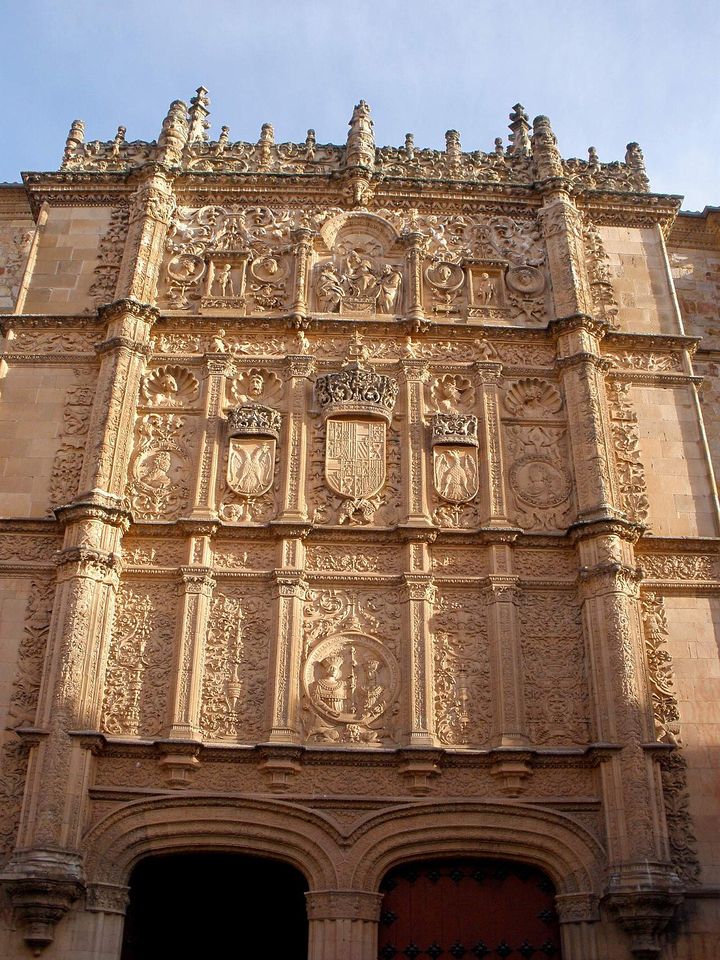
Façade of the Escuelas Mayores of the University of Salamanca (16th century). Photo: Zarateman, 2016, CC0. File on Wikimedia Commons Novitiate
He does his novitiate in Medina del Campo, the first stage in the training of every Jesuit.
Sources: RAH
Vows and Arts studies
He takes his religious vows in Ávila and studies Arts, that is, philosophy, there for three years. He was starting theology when the Visitor Alessandro Valignano chose him for the missions in the East.
Note The year 1571 comes from the association's page. The Real Academia de la Historia places his three years of Arts in Ávila, and González Bolado his vows; neither gives the year. In his 1589 letter, quoted by González Bolado, Céspedes says that, having finished Arts and starting theology, he was sent to India “del mismo collegio de Salamanca” (from the same college of Salamanca).
Sources: RAH, González Bolado 2021, Xihuela
Bound for the East
He sails from the port of Lisbon with Valignano and a group of Jesuit missionaries bound for India.
Sources: RAH, González Bolado 2021
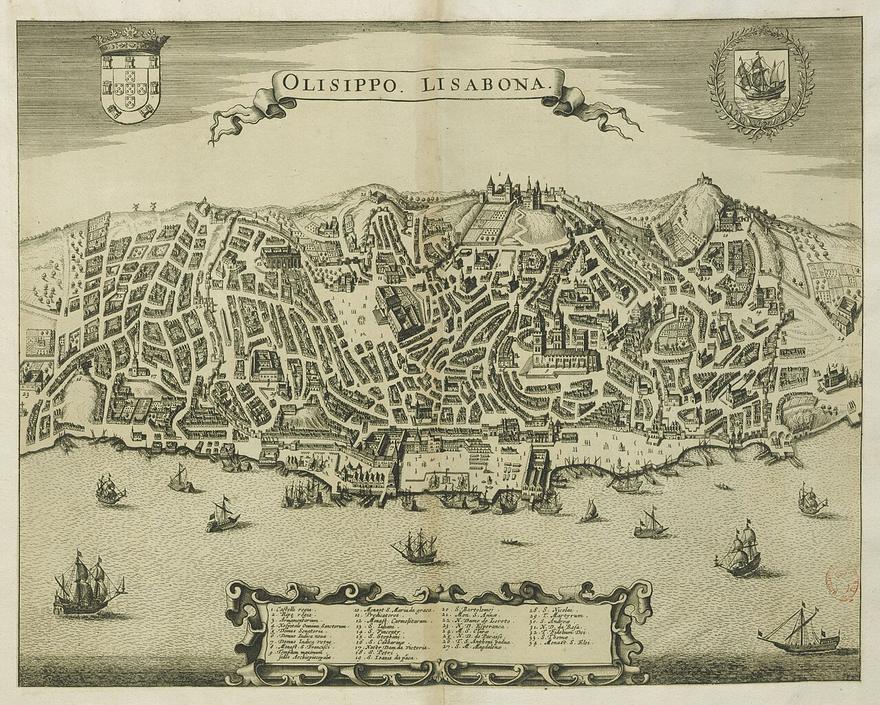
“Olisippo. Lisabona”, a view of Lisbon in an engraving from the late 16th or the 17th century, later than the voyage. Bibliothèque nationale de France. Public domain. File on Wikimedia Commons Ordained in Goa
He reaches Goa, the capital of Portuguese India, on 6 September. He studies theology there for a year and a half and is ordained a priest.
Sources: RAH, González Bolado 2021
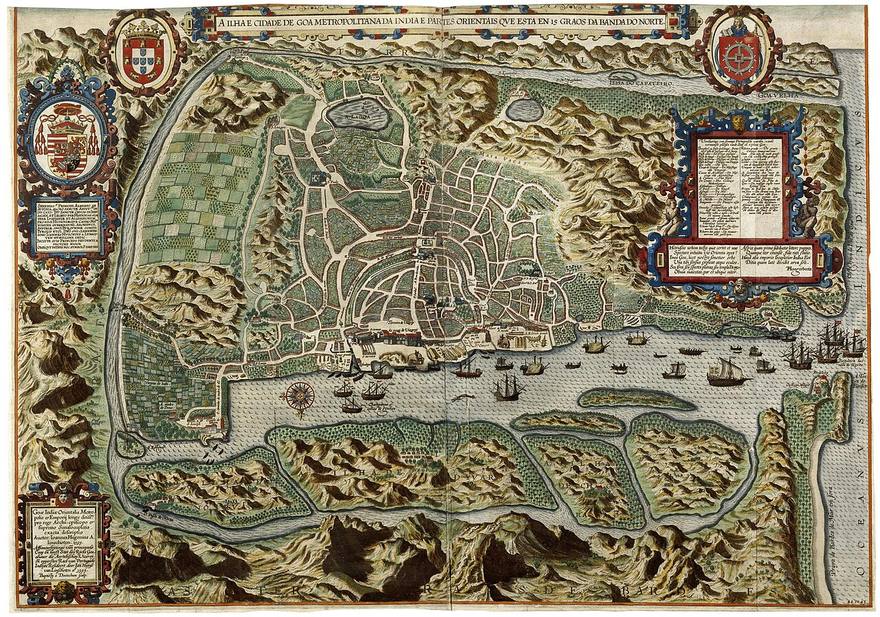
The island and city of Goa, an engraving published in Jan Huygen van Linschoten's Itinerario (Amsterdam, Cornelis Claesz, around 1596; the plate is dated 1595). Koninklijke Bibliotheek. Public domain. File on Wikimedia Commons Stopover in Macao
He completes his training in Macao, the Portuguese port on the coast of China, before going on to Japan.
Sources: RAH
Arrival in Japan
He arrives in Japan, where he will spend the rest of his life. He spends his first year learning the language; according to González Bolado, in the domain of Ōmura, whose lord was a Christian.
Note The association's page places his arrival in Nagasaki. Neither the Real Academia de la Historia nor González Bolado names the port. The year fits his 1589 letter, in which Céspedes says he has been in Japan for twelve years.
Sources: RAH, González Bolado 2021, Xihuela
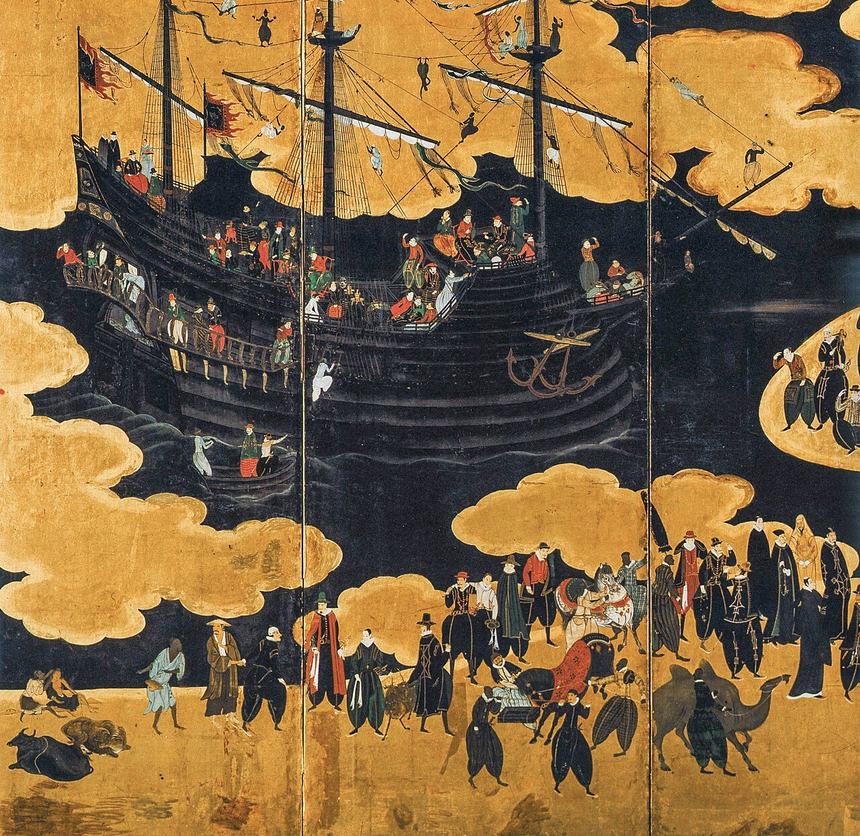
A large Portuguese ship (nau) and European merchants with horses and camels. Left screen of the namban pair attributed to Kanō Naizen (around 1600), detail. Museu Nacional de Arte Antiga, Lisbon. Public domain. File on Wikimedia Commons Nine years in central Japan
He works in Miyako, the capital, in Mino and in Osaka. He is the first missionary to meet Hosokawa Tama, who will be baptised Gracia. He befriends Konishi Yukinaga, a Christian lord. In July 1587 Toyotomi Hideyoshi decrees the expulsion of the missionaries.
Sources: RAH, González Bolado 2021
Hard years in Kyūshū
After the decree he spends months in hiding and on the move. He takes refuge in the lands of Arima, where in 1592 he is vice-rector of the Jesuit house. In Nagasaki he is for a time secretary to the vice-provincial Pedro Gómez. According to the Real Academia de la Historia, his part in the sale of a young Japanese slave girl caused a scandal and he had to leave.
Note González Bolado reports a hypothesis: that sending him to Korea was also a way of removing him from Nagasaki over this affair. The exact order of these posts is not clear in the sources consulted.
Sources: RAH, González Bolado 2021
Waiting on Tsushima
Konishi Yukinaga, baptised Agustín, asks for a priest for the Christian soldiers, who had gone more than a year without hearing mass or sermons. Pedro Gómez sends Céspedes with a Japanese Jesuit brother, León Hankan. They spend eighteen days on Tsushima, and a storm drives them back to port on their first attempt to cross.
Sources: González Bolado 2021, RAH
The first documented European in Korea
He lands on the feast of St John the Evangelist and stays in the fortress Konishi had built at Ungcheon, which Jesuit sources spell Comugai or Comungai. He is the first European whose presence in Korea is recorded in documents. Ungcheon is now in Jinhae (Chinhae), the city twinned with Villanueva de Alcardete, which is now part of Changwon.
Sources disagree The Jesuit chronicler Luis de Guzmán dated his arrival to 1594, a mistake pointed out by González Bolado. González-Bolado also mentions, unconfirmed, the possible wreck of a Portuguese ship in Korea in 1577: if proven, Céspedes would not be the first Westerner to set foot in the country. The Real Academia de la Historia stresses that his visit was pastoral and humanitarian and that he never served as a military chaplain.
Sources: González Bolado 2021, González-Bolado 2024, RAH, Xihuela
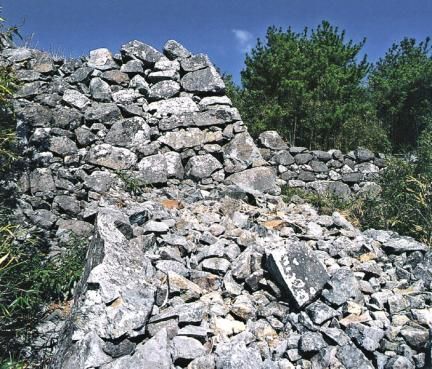
Remains of the wall of the Japanese castle at Ungcheon (웅천왜성), Changwon. Photo: Cultural Heritage Administration of Korea (문화재청), 1998. KOGL Type 1 / CC BY-SA 4.0. File on Wikimedia Commons Letters from Korea
He visits other Japanese fortresses on the coast, such as Gijang. He sees the soldiers suffer hunger, cold and disease. Four of his letters from Korea are known, three of them only through partial copies or summaries by Luís Fróis; they are the first written testimony by a European in the country. In one he notes, in Portuguese, that “os frios deste Corai são muito grandes, e sem comparação maiores que os de Japão” (the cold in Korea is very great, and beyond comparison greater than in Japan).
Note According to González Bolado, the letters say little about the country itself: Céspedes moved within the Japanese fortresses and had little contact with the Korean population.
Sources: González Bolado 2021, González-Bolado 2024
Return to Japan
Katō Kiyomasa, Konishi's rival, accuses Konishi before Hideyoshi of keeping a priest in Korea against his orders. To avoid trouble, Konishi sends Céspedes back to Japan. On Tsushima, Doña María, Konishi's daughter and lady of the island, entrusts him with a captive Korean boy, the son of the Korean king's secretary, to be brought up by the Jesuits. Céspedes takes him to Nagasaki.
Sources disagree The Real Academia de la Historia dates his return to April-May 1595, but González-Bolado (2024) dates his writings from Korea between 27 December 1593 and 8 June 1595. Céspedes himself says in a letter of 1597 that he stayed there “a year”; González-Bolado also speaks of six months spent visiting the fortresses.
Sources: RAH, González Bolado 2021, González-Bolado 2024
Superior at Nakatsu
He is superior of the Jesuit residence at Nakatsu, in the province of Buzen, in northern Kyūshū.
Sources disagree The Real Academia de la Historia places him at Nakatsu from his return from Korea. González Bolado only documents him there from 1599; in 1597 he was writing from Arima.
Sources: RAH, González Bolado 2021
The church at Kokura
He founds the church at Kokura, also in Buzen, under the protection of Hosokawa Tadaoki, husband of Gracia. He lives there for his last nine years.
Sources: RAH, González Bolado 2021
Death
He dies suddenly at Kokura; according to González Bolado, of apoplexy. He had spent some thirty-four years in Japan. After his death the lord of Kokura begins to persecute the Christians.
Sources: RAH, González Bolado 2021


Base map © OpenStreetMap. The lines join the stages with approximate strokes and do not show the actual route. Sea crossings (dashed lines) are drawn schematically via the Cape of Good Hope and the Strait of Malacca, the Portuguese routes of the time to India and the Far East.
Sources for this section
- Javier Burrieza Sánchez, “Gregorio de Céspedes”, Diccionario Biográfico electrónico (online Biographical Dictionary), Real Academia de la Historia, Madrid. historia-hispanica.rah.es/biografias/11700-gregorio-de-cespedes
- Jaime González Bolado, “Cruces y katanas en Corea: los cristianos en la Guerra Imjin (1592-1598)”, Asiadémica, 16 (2021), pp. 111-137 (in Spanish). It quotes Jesuit documents from the Roman Archives of the Society of Jesus and Park Chul's book on Céspedes (Madrid, Spanish Ministry of Foreign Affairs, 1986), based on his doctoral thesis (Universidad Complutense, 1985). dialnet.unirioja.es/servlet/articulo?codigo=9125192
- Jaime González-Bolado, “Discovering Korea through Iberian Writings of the Sixteenth and Seventeenth Centuries”, European Journal of Korean Studies, 24, 1 (2024), pp. 101-124. ddd.uab.cat/pub/artpub/2024/301276/revdiskor_a2024v24n1.pdf
- Real Academia Española, page on its corresponding member Park Chul, which calls Céspedes “originario de Villanueva de Alcardete (Toledo)” (a native of, or of a family from, Villanueva de Alcardete). www.rae.es/academico/park-chul
- Xihuela, “Gregorio de Céspedes”, the association's page on him on this website. /en/gregorio-de-cespedes/
- Valentín Dorado Dellmans, “Un jesuita madrileño en Corea”, Anales del Instituto de Estudios Madrileños, XXXIV (1994), pp. 565-568. dialnet.unirioja.es/descarga/articulo/699503.pdf
- Park Chul, “Gregorio de Céspedes, primer visitante europeo de Corea”, Biblioteca Virtual Miguel de Cervantes. www.cervantesvirtual.com/research/gregorio-de-cespedes-primer-visitante-europeo-de-corea/0dc55eaf-7f34-4a1b-9e35-d87a75beee88.pdf
Images
- Façade of the Escuelas Mayores of the University of Salamanca (16th century). Photo: Zarateman, 2016, CC0. File on Wikimedia Commons
- “Olisippo. Lisabona”, a view of Lisbon in an engraving from the late 16th or the 17th century, later than the voyage. Bibliothèque nationale de France. Public domain. File on Wikimedia Commons
- The island and city of Goa, an engraving published in Jan Huygen van Linschoten's Itinerario (Amsterdam, Cornelis Claesz, around 1596; the plate is dated 1595). Koninklijke Bibliotheek. Public domain. File on Wikimedia Commons
- A large Portuguese ship (nau) and European merchants with horses and camels. Left screen of the namban pair attributed to Kanō Naizen (around 1600), detail. Museu Nacional de Arte Antiga, Lisbon. Public domain. File on Wikimedia Commons
- Remains of the wall of the Japanese castle at Ungcheon (웅천왜성), Changwon. Photo: Cultural Heritage Administration of Korea (문화재청), 1998. KOGL Type 1 / CC BY-SA 4.0. File on Wikimedia Commons
What links him to Villanueva de Alcardete
His family. Whether he was born in Madrid, where his father was corregidor, or in Villanueva, his parents were from here: Valentín Dorado writes that his father «was born in Villanueva de Alcardete (Toledo)», and Park Chul that his mother, doña María de Simancas, was «a native of Villanueva de Alcardete». That is why the village has always considered him its own, why it opened a cultural centre in his name in 1991, and why it is twinned with the Korean city where he landed. Neither author cites the specific record; confirming it in the parish archive would be the final proof.
The association does not have, today, any document of its own from the municipal or parish archives that mentions Gregorio de Céspedes. The baptismal record would be the definitive proof, and we do not know from what year the parish baptismal registers survive, nor where they are.
Why he matters to the village
He is the best-known native of Villanueva outside Spain. Villanueva de Alcardete is twinned in his honour with the Korean city of Chinhae, today part of Changwon, and has streets named Corea, Seúl and Chinhae. The year of the twinning varies between sources: 1991 or 1993. It is a link that almost no village of 3,000 inhabitants has, and one that the association wants to look after with serious research, not empty celebration.
What is not documented
- The exact place of birth: Villanueva de Alcardete or Madrid. Where to look: the parish sacramental registers, the Real Academia de la Historia, Jesuit sources. Difficulty: medium.
- The year of the twinning with Chinhae/Changwon (1991 or 1993). Where to look: municipal minutes.
- Any document in the municipal archive about the Céspedes de Oviedo family in the 16th century. Where to look: notarial records from 1528 onwards.
Call to researchers
If you research Gregorio de Céspedes, the Jesuit missions in Japan or the war of 1592-1598, from Korea, Japan or anywhere else, we want to talk to you. The association can help with access to the local archives and is looking for collaboration to settle the question of his birthplace. Write to us through Contact, or see Are you researching? (in Spanish).
Sources
- Real Academia de la Historia, Diccionario Biográfico electrónico: entries for Gregorio de Céspedes and Fernando Céspedes de Oviedo.
- Villanueva de Alcardete Town Council, history and twinning.
The specialised bibliography on Céspedes’s letters will be added once the association has reviewed it. See also Bibliography (in Spanish).
Back to People (in Spanish) or to the English home page.
Text under review. This page was written from the association’s white paper and is awaiting validation by the board. The Spanish version is the reference. If you spot an error, write to us.